
Midjourney Official Prompt Guide: 10 Stunning AI Art Prompts Step-by-Step
MidassAI Team · July 11, 2026 · 5 min read
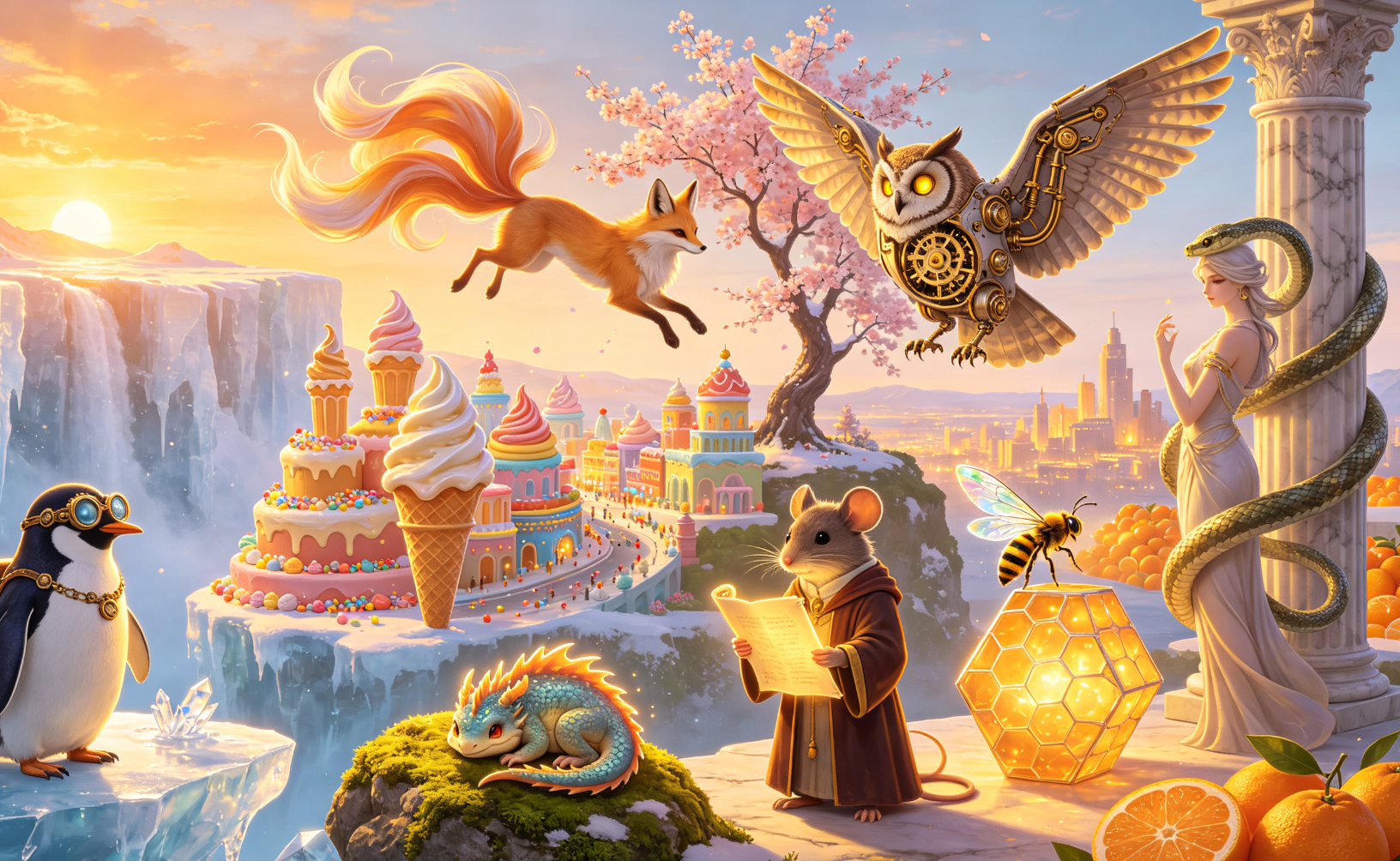
Step 1: Set Up Your Midjourney Environment
Ensure you’re on Discord with Midjourney v6 enabled. Use /settings to confirm --v 6 is active. Enable fast mode (/prefer fal) for quicker iterations.
Step 2: Build Each Prompt Using the 4-Part Formula
For every subject (e.g., 企鹅, 日出), apply this structure:
- Subject: Clear noun + descriptor (e.g., "majestic emperor penguin")
- Style: Art medium or artist reference (e.g., "Studio Ghibli illustration")
- Modifiers: Lighting, mood, detail flags (e.g., "golden hour lighting, ultra-detailed, 8k")
- Parameters:
--v 6 --style raw --s 750
Step 3: Refine with Negative Prompts & Aspect Ratios
Add --no text, blurry, deformed to suppress artifacts. Use --ar 16:9 for landscapes (日出, 柚子城) and --ar 1:1 for characters (九尾狐, 蛇女). Test variations with --q 2 for higher fidelity.
| Feature | Benefit |
|---|---|
| Speed | Faster iteration with --fast mode |
| Quality | Better coherence and detail in v6 |
Step 4: Iterate Based on Output Analysis
Compare initial outputs against your intent. If 龙宝宝 looks too aggressive, add --stylize 500 and swap "ferocious" for "playful, chubby, glowing eyes". Save successful prompts as templates.
Quick Takeaways
Prerequisites and setup
Before crafting prompts, verify you have access to Midjourney’s latest infrastructure: a Discord account linked to an active Midjourney subscription (Basic or higher), and the official Midjourney bot added to your server. You must be in a channel where the bot is permitted to post—check permissions if /imagine commands fail silently. Crucially, this guide assumes Midjourney v6 with --style raw enabled, as it delivers the strongest prompt adherence and photorealistic control. Avoid legacy versions (--v 5.2) or experimental flags like --niji unless intentionally targeting anime aesthetics—those diverge significantly from the v6 behavior described here. Also confirm your Discord client supports image previews (desktop or mobile app; browser extensions may interfere).
Ensure your environment is clean: disable third-party prompt enhancers or auto-formatting bots that might strip parameters or inject unintended tokens. Midjourney v6 parses prompts left-to-right, so parameter order matters—always place --v 6 first, followed by --style raw, then aspect ratio and stylization. No commas between parameters; spaces are non-negotiable separators.
Extended prompt workflow
Start with subject anchoring: Name exactly what you want—not “a fox” but “nine-tailed kitsune spirit, translucent silver fur, floating cherry blossom petals clinging to tail tips”. Ambiguity here cascades: “fox” yields generic red canids; “kitsune spirit” triggers Japanese folklore semantics in v6’s training data.
Lock style before modifiers: Insert style references immediately after the subject, separated only by a comma. Example:
“cyberpunk street food stall, neon-drenched ramen cart, photorealistic DSLR shot, f/1.4 shallow depth of field”. Notice “photorealistic DSLR shot” defines medium before lighting (“neon-drenched”)—this prevents v6 from misinterpreting “neon” as an art style instead of illumination.Layer modifiers with precision: Use concrete sensory terms—not “beautiful lighting” but “backlit by suspended bioluminescent jellyfish, soft volumetric glow, rim light on cheekbones”. Avoid subjective adjectives (“epic”, “amazing”)—they dilute signal. Instead, deploy technical cues:
“subsurface scattering on skin”, “anamorphic lens flare”, “Kodak Portra 400 grain structure”.Parameter sequencing is non-optional: Always order as
--v 6 --style raw --ar 2:1 --s 900 --q 2. Why?--style rawmust follow--v 6to activate v6’s unfiltered interpretation;--arbefore--sensures resolution scales correctly to your canvas;--q 2amplifies detail after composition locks in. Skipping--s 900(vs default--s 100) often fixes “flat” textures in complex scenes.Negative prompting as surgical tool: Go beyond
--no text, blurry. Target specific failure modes:--no duplicate limbs, asymmetrical eyes, fused fingers, plastic skin texturefor humanoid subjects;--no gradient sky, flat clouds, uniform grassfor landscapes. Test one negative term at a time—overloading--noclauses confuses v6’s latent space balancing.Validate via controlled variation: Run three variants in sequence:
• Base:“steampunk librarian, brass-gear spectacles, warm library lighting, oil painting” --v 6 --style raw --ar 4:5
• Refine: Add--s 850 --q 2and swap “oil painting” → “Rembrandt chiaroscuro lighting”
• Stress-test: Append--no modern clothing, digital UI elements, visible seams
Compare outputs pixel-by-pixel—not just aesthetics, but semantic fidelity (e.g., does “brass-gear spectacles” render interlocking gears, not just metallic frames?).
Common mistakes
Using commas inside descriptors: Writing
“a dragon, with glowing eyes, and scaled wings”breaks v6’s parsing—commas separate prompt segments, not clauses. Fix:“a dragon with glowing eyes and scaled wings”(no internal commas) or use hyphens:“dragon-glowing-eyes-scaled-wings”.Forgetting parameter scope:
--s 750applies only to that prompt. If you rerun with new modifiers but omit--s, v6 reverts to default stylization strength (100), flattening nuance. Always repeat critical parameters in every variant.Overloading style references: Combining
“Van Gogh brushstrokes, Pixar animation, hyperrealistic macro photo”forces v6 into contradictory modes. Pick one dominant style anchor (“Van Gogh brushstrokes”) and support it with compatible modifiers (“thick impasto texture, swirling starry background, vibrant cadmium yellow palette”).
Try this in MidassAI
MidassAI Studio streamlines this entire workflow with visual parameter toggles and real-time prompt diagnostics—no Discord switching or manual /settings checks. Paste any v6 prompt (e.g., “bioluminescent deep-sea anglerfish, ultra-macro lens, dark teal ambient light, 8k photorealism” --v 6 --style raw --ar 16:9 --s 900) directly into the Studio editor, then click “Analyze Prompt” to see which terms Midjourney v6 will prioritize, detect potential conflicts (like clashing styles), and auto-suggest negative prompts based on common artifact patterns for marine subjects. You’ll get identical v6 outputs—but with version-locked rendering, batch iteration history, and one-click parameter optimization. Skip the Discord friction and test your refined prompts instantly: MidassAI Midjourney Pro Studio