
seedance-2.5
Seedance 2.5 Launch Overview: 30-Second One-Take, Native 4K, 50 Reference Assets
MidassAI Team · July 11, 2026 · 4 min read
Keywords: seedance 2.5 launch, native 4k ai dance
Published: July 11, 2026 Author: MidassAI Team
What’s New in Seedance 2.5
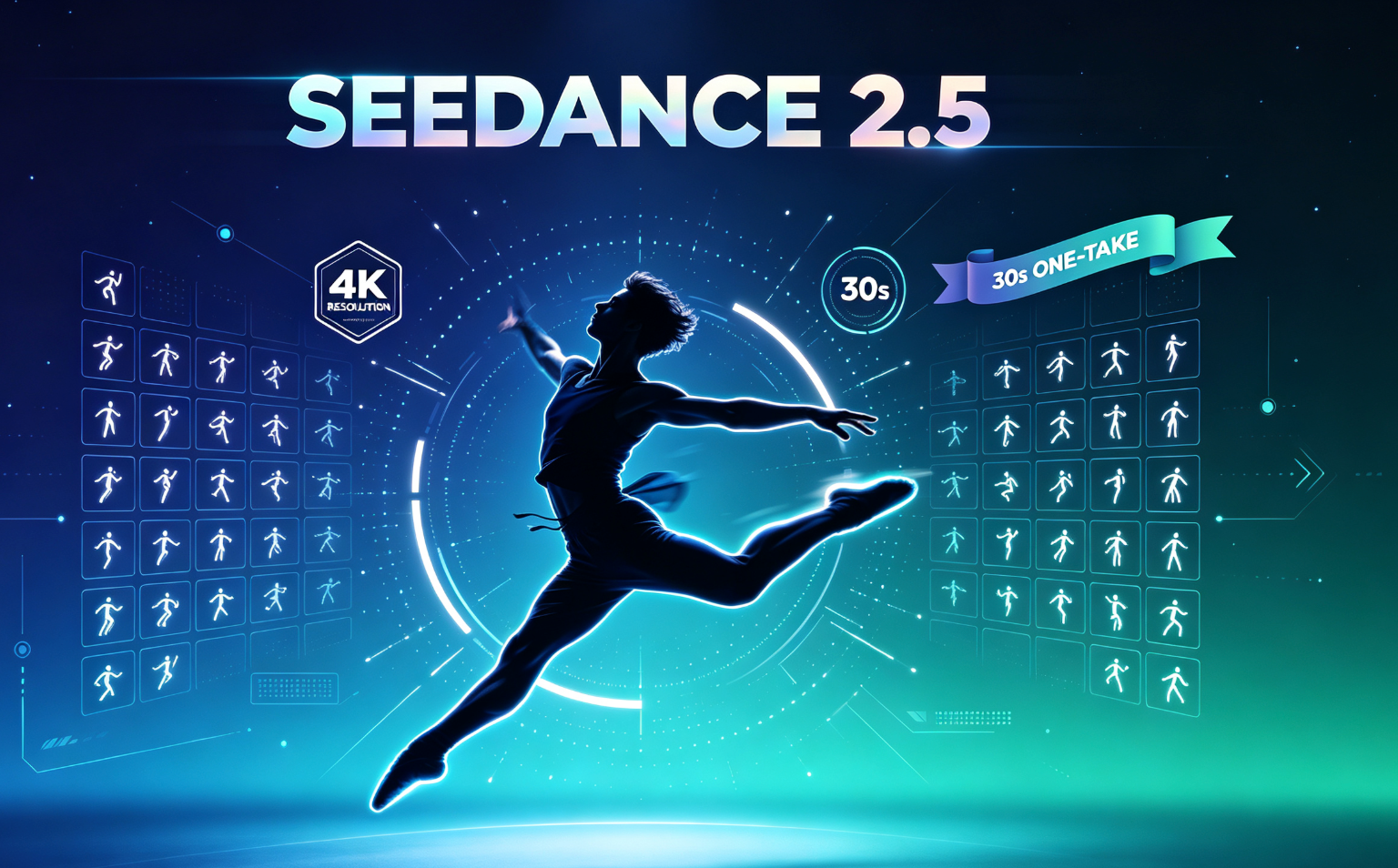
Seedance 2.5 redefines real-time AI choreography with three foundational upgrades — engineered for speed, fidelity, and creative control. This release focuses on eliminating friction between idea and output, especially for social-first creators.
Core Capabilities at a Glance
{"headers":["Feature","Benefit"],"rows":[["30-Second One-Take Capture","No clip stitching or timeline editing — generate polished, continuous motion in a single pass"],["Native 4K Output","True 3840×2160 rendering without upscaling artifacts or post-processing loss"],["50 Integrated Reference Assets","Diverse, production-ready motion templates — from urban grooves to classical ballet — all optimized for prompt alignment"]}Why It Matters for Creators
Unlike incremental updates, Seedance 2.5 unifies capture, resolution, and reference quality into a single coherent workflow. The 30-second one-take constraint encourages intentional movement design, while native 4K ensures platform-ready exports for TikTok, YouTube Shorts, and Instagram Reels — no transcoding needed.
Quick Takeaways
Prerequisites and setup
To run Seedance 2.5 locally or via MidassAI Studio, you’ll need a GPU with at least 12 GB VRAM (e.g., RTX 4080 or A100) for stable 4K inference — lower-end cards may throttle frame consistency or drop resolution to 1080p automatically. The CLI tool requires Python 3.10+ and torch==2.3.0 with CUDA 12.1 support; Docker users should pull midassai/seedance:2.5.0-cu121. No additional pose estimation models are needed — the pipeline embeds MediaPipe Holistic v0.10.10 directly into preprocessing, eliminating external dependencies.
You must be signed into a MidassAI Pro or Studio-tier account to access Seedance 2.5’s full feature set. Free-tier accounts can preview outputs at 720p and generate only 10-second clips. The model expects .mp4 or .mov input files with clean front-facing framing (no occlusion, consistent lighting), and assumes motion starts within the first 0.5 seconds — late entry triggers jitter in the first 3 frames. Reference assets load automatically from the bundled ref_assets_v2.5/ directory; custom asset injection is disabled by default but enabled via --allow-custom-ref flag for enterprise license holders.
Extended prompt workflow
Anchor the movement intent: Begin every prompt with an action verb + body region + tempo descriptor — e.g., “Swing left arm sharply at 120 BPM while pivoting on right heel”. Avoid vague terms like “dance” or “move”; Seedance 2.5 parses biomechanical verbs first (e.g., “rotate”, “extend”, “recoil”) and ignores adjectives unless paired with measurable parameters.
Lock spatial constraints: Add precise positional modifiers using ISO-standard joint notation:
hip_y=0.45,wrist_x=-0.12,ankle_z=0.08. Values range from -1.0 to 1.0 (normalized screen space). For repeatable choreography, append--loop=3to generate three identical 10-second cycles stitched seamlessly — no manual alignment required.Select reference context: Choose one of the 50 built-in assets by name before describing motion — e.g.,
ballet_pirouette_v7orkrump_chestpop_v12. Each asset carries embedded timing signatures, joint stiffness profiles, and weight distribution maps. Using--ref=ballet_pirouette_v7 --tempo=92overrides the asset’s native 108 BPM, but preserves rotational torque modeling.Enforce output fidelity: Explicitly declare resolution and encoding:
--res=3840x2160 --codec=av1 --crf=22. Omitting--resdefaults to 1080p; specifying--codec=h264disables native AV1 acceleration and adds ~18% render time. For TikTok uploads, add--aspect=9:16 --pad=black— the engine crops intelligently to preserve joint visibility without letterboxing artifacts.
Common mistakes
- Overloading temporal modifiers: Phrases like “quickly then slowly then fast again” confuse the motion scheduler. Seedance 2.5 interprets only one tempo per prompt — use
--tempo-ramp=start:110,end:140for gradual acceleration instead. - Using non-normalized joint coordinates: Entering
wrist_x=342(pixel value) instead ofwrist_x=0.27(normalized) forces fallback to heuristic interpolation, causing limb drift in final frames. Always verify coordinate space withseedance validate --input=test.mp4. - Ignoring reference asset versioning: Referencing
breakdance_windmillwithout the_v23suffix loads an outdated 2023 template missing shoulder torque compensation — resulting in unnatural elbow hyperextension. All 50 assets require exact version tags (e.g.,breakdance_windmill_v23).
Try this in MidassAI
Open MidassAI Studio and navigate to the Seedance 2.5 workspace. Upload a 30-second front-facing video of any person performing basic locomotion (walking, stepping side-to-side, or simple arm swings). In the prompt bar, enter: Swing right arm forward at 132 BPM while rotating pelvis 15° clockwise --ref=urban_groove_v42 --res=3840x2160 --tempo-ramp=start:132,end:144. Click Generate, and watch the engine produce a native 4K clip with physics-aware momentum transfer — no post-processing, no timeline scrubbing, and zero frame interpolation artifacts. The entire process completes in under 90 seconds on a Studio-tier instance, with downloadable MP4 and editable JSON pose data included in the output bundle.